By Courtney Manton | Created on 7th September 2026
Buying property in South Kensington means negotiating a market that traditionally attracts global interest, with buyers drawn to its Victorian stucco townhouses and heritage.
But what home suits your needs best in the area?
If you’re wondering what homes are like here, then keep reading our guide, which outlines the property offering in South Kensington to buy, rent or invest in the area.
Overview of South Kensington property
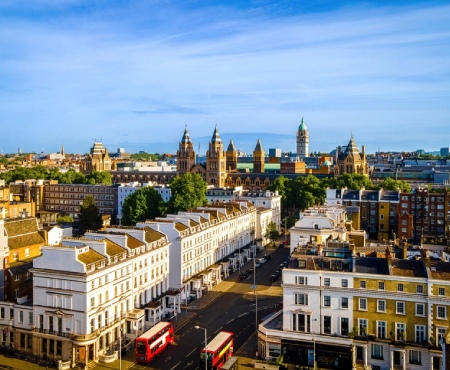
SW7 is overwhelmingly mid-to-late 19th Century in its architecture, for good reason – its was built in the wake of the Great Exhibition of 1851, which formed the foundations of the museum quarter. Purpose-built mansion blocks add a further layer of Edwardian and early 20th Century design, particularly along the Cromwell Road.
Compared to neighbouring Chelsea, South Kensington has proportionally more converted flats and fewer freehold houses available at any one time, making unconverted houses scarce and allowing them to command a premium. Read on to learn more about the property types and architecture you will encounter when buying in South Kensington.
Types of Property in South Kensington
Property Type
Typical Period
Typical Tenure
Approximate Price Range
Converted flat (stucco terrace)
1850s–1890s
Leasehold
£800,000–£3,000,000+
Purpose-built mansion flat
1890s–1920s
Leasehold
£700,000–£2,500,000
Terraced townhouse (whole)
1850s–1890s
Freehold or share of freehold
£3,500,000–£9,000,000+
Mews house
1850s–1900s
Freehold or leasehold
£1,500,000–£4,000,000+
New build / modern conversion
2000s–present
Leasehold or freehold
Varies
Converted flats make up the vast majority of the homes on the South Kensington property market, and what striking flats they are. Many of them sit within the grand stucco-fronted terraces of Onslow Square, Cranley Gardens, Gloucester Road, and the streets running between Fulham Road and Old Brompton Road. Built as single family homes and subsequently divided, these iconic buildings often hold two to four flats. Buyers will encounter a wide range of conversion qualities, however – some retaining original room proportions and features throughout, while others have been reconfigured less sympathetically.
Purpose-built mansion blocks, like those along Queen’s Gate, Cromwell Road, and around the private green space of Courtfield Gardens, were designed to offer pied-a-terres with the London Season in mind. Designed for apartment living, they offer communal areas and porter services in the grander buildings. Ceiling heights can be lower than in converted houses of the same period, but their structural integrity and sound insulation can be more consistent.
It’s rare to find whole, terraced townhouses in active listings and when they do appear, they command a significant premium. However, mews houses offer freehold or share-of-freehold ownership at a lower price point – terraced mews houses in Onslow Mews West sell for an average £2.75 million as per Rightmove. Often providing two or three bedrooms, with sought-after private garage or parking, they can prove popular with buyers.
South Kensington’s Historic Buildings
South Kensington falls within the Royal Borough of Kensington and Chelsea, which has one of the highest concentrations of designated conservation areas in London. Buyers will find that one leads up to the boundary of the next conservation area, each prioritising certain aspects of the local architecture and overall atmosphere. This is an advantage for buyers as it tends to preserve a period property’s appeal in the long run – but you must also follow strict guidelines where renovations are concerned. The RBKC designation can specify what works you can or cannot undertake, or restrict the materials and methods you can use.
Local conservation areas include:
Thurloe and Alexander Conservation Area. Covers the streets immediately south and west of the Victoria and Albert Museum, including Thurloe Square, Alexander Square, and Onslow Gardens. The architectural character here is set by the slightly earlier Italianate terraces developed from the 1840s onwards, and Victorian stucco terraces.
The Boltons Conservation Area. To the south-west, covering The Boltons oval and its surrounding streets, this area contains some of the most architecturally significant mid-Victorian villas in London.
The Victoria and Albert Museum and the Natural History Museum are both Grade II* listed, unsurprisingly, but Historic England’s listed building records list many residential properties across SW7.
Buyers of listed buildings must be extremely cautious about undertaking works, and seek specialist advice before commencing as the penalties can be severe.
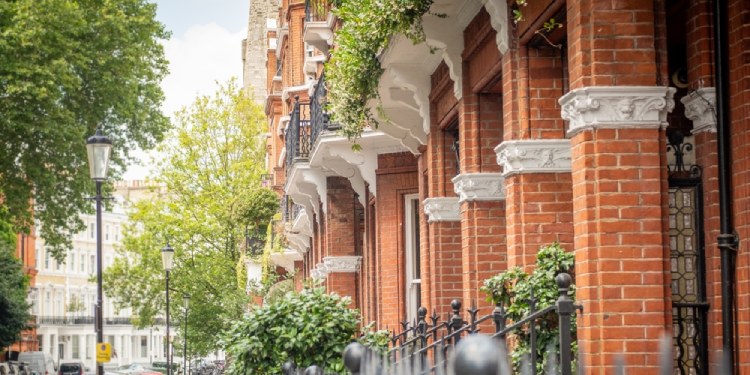
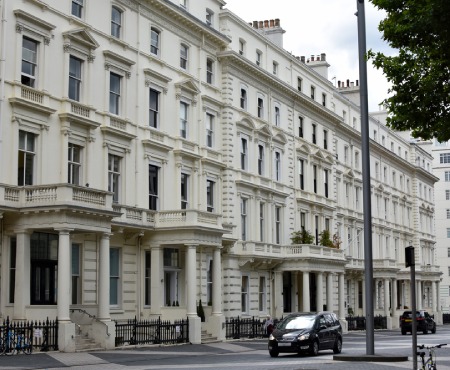
Rendered and painted stucco facades, typically cream or white
Corinthian or Ionic pilasters and elaborate cornicing at eaves level
Full-height bay windows to principal floors
Sash windows throughout, often with decorative glazing bars
High ceiling heights, commonly 3.5m or above on ground and first floors
Panelled entrance doors with fanlights and columned porticos
Rear gardens of variable depth, depending on street
These imposing homes define South Kensington’s aesthetic, but of course, there are practical considerations. Buyers should be aware that stucco, while beautiful when well maintained, requires periodic repainting and can conceal defects in the brickwork beneath. In converted flats, the original ceiling heights and cornicing are often best preserved on the upper-ground and first floors, while lower-ground conversions typically involve more alteration.
Edwardian and Early Twentieth-Century Mansion Blocks (1890s–1920s)
Red brick or terracotta facades, often with Dutch gable details
Communal entrance halls with original tiling and ironwork in the better-preserved examples
Larger window openings than their Victorian predecessors
Service lifts and back staircases in the grandest buildings
Consistent floor plates with lower ceiling heights than converted houses
The mansion blocks around Queen’s Gate and Courtfield Gardens can offer practicality along with period character – an ideal combination for many buyers. Lift access, porter services, and sinking funds are worth finding out more about before buying, as these can all vary quite a bit.
Mews Houses (1850s–1900s)
Originally stable blocks and coach houses serving the principal terraces
Two or three storeys following conversion
Cobbled or brick-paved mews settings, generally traffic-quiet
Frequently refurbished to a high standard, with roof terraces added where permitted
Garage or off-street parking typically included
Mews houses attract buyers who want freehold ownership at a lower entry price than a full terrace. The trade-off is ceiling height, particularly on ground floors, but they often come with the elusive features of private outdoor space and parking.
Recent Developments and New Builds in South Kensington
Large-scale new residential development is rare in South Kensington given its protected historical architecture. However, the Around Station Development linked to the South Kensington station upgrade is set to bring 50 new homes on land along Pelham Street, including affordable housing on currently vacant land, alongside a new accessible station entrance on Thurloe Street, reinstated retail units, and a new four-storey building with commercial and office use. Detailed design and procurement work is underway in 2026, with early implementation work expected later in the year.
Beyond this, new build activity in SW7 is largely confined to high-specification refurbishments and reconfiguration of existing period buildings rather than ground-up construction. This is perhaps no surprise, given the area’s reputation for period architecture – many buyers move here specifically to live within South Kensington’s period architecture.
Gardens in South Kensington
Private gardens can be more limited in South Kensington than in lower-density parts of London, though residents are never far from leafy surroundings and parks.
The principal terraces on Onslow Square, Cranley Gardens, Thurloe Square, and Alexander Square front onto private communal gardens. These well-maintained, mature garden squares are highly regarded, and exclusive by nature. Residents of flats and houses in the surrounding terraces generally hold a key to the garden square as part of their tenure arrangements.
Rear gardens for whole terraced houses vary in depth by street and plot. Many have been extended at lower-ground level, reducing their garden depth in the process. Flats in converted terraces may have access to a share of the rear garden, a private terrace, or no outside space at all. This varies by conversion layout and lease, and buyers should check carefully.
Mews houses, however, often come with private outside space, in the form of a small courtyard or patio to the front or rear, or roof terrace where permitted development or planning consent has been obtained. They also often include a garage or designated parking space, a valuable feature in South Kensington where off-street parking in scarce in the main residential streets. Most residents rely on resident parking permits within RBKC’s controlled parking zone.
Buying in South Kensington: What to Check
South Kensington’s high property prices, and period properties which often have a history of conversion, mean buyers should not overlook the value of a detailed pre-purchase survey. A RICS Level 3 Building Survey is strongly recommended for any Victorian or Edwardian property in South Kensington, and essential for listed buildings or properties with visible signs of alteration. These are some of the issues that can arise:
Stucco condition and brickwork beneath. Cracked or poorly maintained render can conceal long-standing moisture ingress into the underlying brick; a full structural survey should specifically assess the facade
Solid wall construction. Victorian terraces have solid brick walls with no cavity, making them susceptible to penetrating damp; check for damp at lower-ground and ground-floor levels particularly
Conversion quality. In converted flats, inspect the standard of structural alterations, the condition of shared areas, and whether any works were carried out with appropriate consents
Flat roofs and roof terraces. Common on mews houses and rear extensions, yet flat roof coverings have a finite lifespan and replacement is a significant cost
Drainage and pipework. Original cast-iron and lead pipework is common in pre-1900 buildings, and a drainage survey is advisable
Chimney stacks. Multiple stacks are standard on Victorian terraces and require periodic repointing. Disused flues can cause damp if cappings fail
Leasehold terms. For flat purchases, check lease length (anything below 80 years triggers significantly higher extension costs), ground rent terms, and the financial health of the service charge and sinking fund
Listed building consents. When buying listed properties, verify that all previous alterations were carried out with the necessary consents, as liability for unlawful works will usually transfer to the buyer
Ready to Buy in South Kensington?
In South Kensington’s property market, buyers will need a strong command of the leasehold conventions, conservation constraints, and the significant variation in quality within what can look, from the outside, like comparable properties. If you are researching a purchase in SW7, contact us to speak with an agent who knows the area in detail. We also invite you to register as a buyer to be kept informed of suitable properties as they become available.
Frequently Asked Questions
What types of property are most common in South Kensington?
The majority of South Kensington properties are leasehold flats within converted Victorian stucco terraces or Edwardian purpose-built mansion blocks. Unconverted terraced townhouses are rare, and as such they command a significant premium, while mews houses offer a more accessible route to freehold ownership.
Are there conservation areas in South Kensington?
Yes, with the principal residential streets falling within the Onslow, Thurloe and Alexander, and The Boltons areas, designated by the Royal Borough of Kensington and Chelsea. Permitted development rights are heavily restricted, and external alterations typically require planning consent so obtain full details before purchasing.
Is most property in South Kensington leasehold or freehold?
The majority of sales in South Kensington are leasehold, being converted and purpose-built flats. Freehold or share-of-freehold ownership is available in the form of terraced houses and mews houses, but these make up a smaller share of the local property market.
What should I check before buying a converted flat in South Kensington?
Always check the lease length, as anything below 80 years triggers higher extension costs. Buyers must also investigate the quality and consent history of the conversion works, condition of shared fabric and communal areas, and the service charge and sinking fund’s condition. A RICS Level 3 survey is strongly recommended as hidden issues can be costly to rectify.
What is the typical price range for property in South Kensington?
South Kensington is among London’s most expensive neighbourhoods. Recent figures from Rightmove estimate an average flat price of around £2.18 million and an average terraced house price of approximately £4.86 million. Mews houses and smaller flats sit below the overall average, but properties priced below £700,000 can be extremely rare.
Share
Courtney Manton
Courtney is a Chartered Surveyor, the senior partner and owner of the Best Gapp group.
His special talent honed over the last 30 years is winning. Winning for his many clients.
Winning a Leasehold Enfranchisement case, winning a negotiation to sell or buy, winning a lower rent at review, winning a planning permission to enhance value, winning trust.